
The Alyra API is not yet public. For details, please contact our team.
Introduction
Alyra is an execution layer that aggregates liquidity and abstracts away the complexity of multi-chain interactions. Our system connects dApps with bridges and DEXs through a single API/SDK, returning deterministic Execution Packets that are safely executed on-chain. This architecture enables seamless cross-chain and same-chain transactions with built-in monitoring, fallback logic, and transparent smart contracts.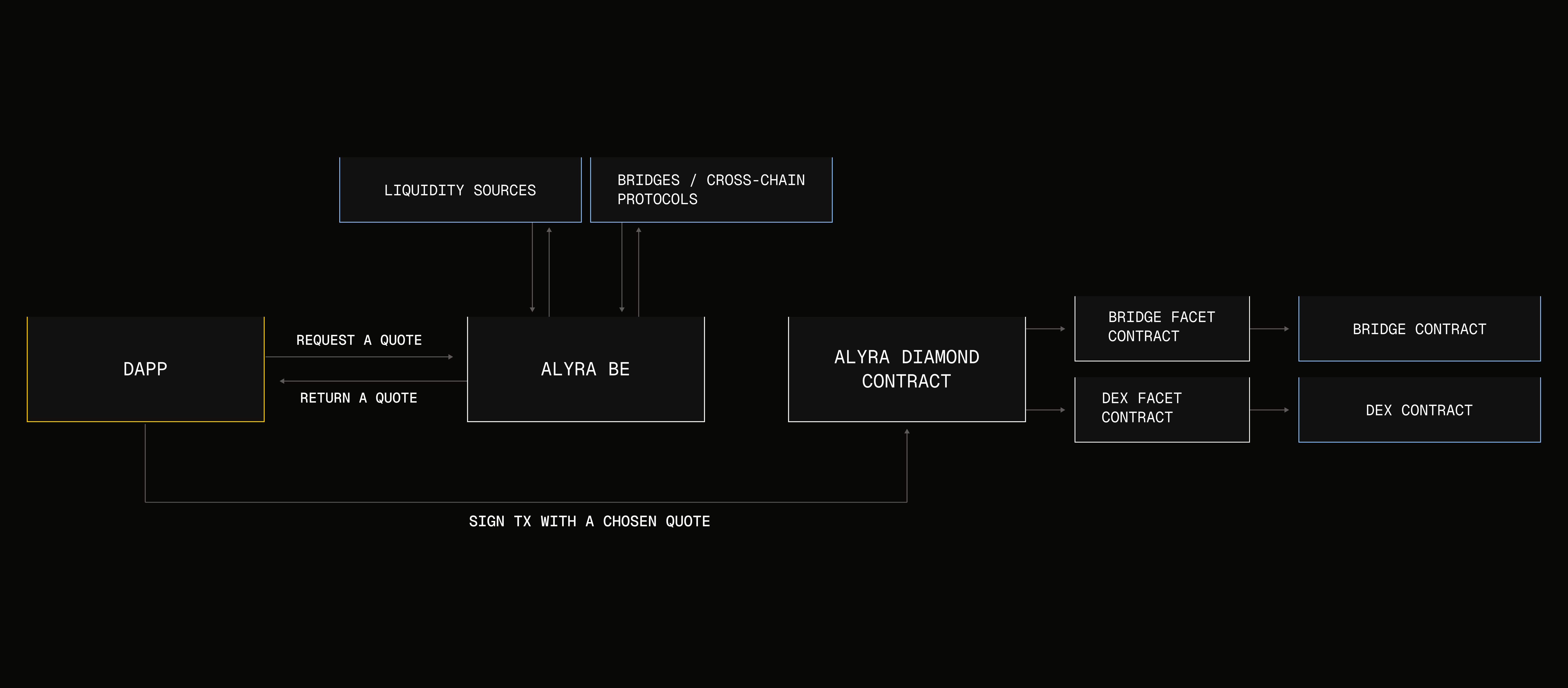
Key Components of Alyra Architecture
1. dApp Integrations
What it is: The entry point where users interact.- How it works: dApps plug into Alyra’s API/SDK to request quotes for swaps or cross-chain transfers. Once the optimal path is chosen, the dApp packages it into a signed Execution Packet and submits it on-chain for processing.
2. Alyra Router (Off-chain Routing)
Purpose: The off-chain aggregation and routing layer. Functions:- Collect pricing and routes from integrated bridges and DEXs.
- Determine the optimal path based on cost, speed, and reliability.
- After identifying the optimal route, Alyra validates the security of the selected path, ensuring that there are no vulnerabilities or risks before proceeding.
- Encode the chosen route and parameters into an Execution Packet for deterministic settlement.
3. Execution Packet
Essence: A structured, signed instruction that defines exactly how a transaction should execute. Contents:- Full route across liquidity sources.
- Minimum output amounts and deadlines.
- Fee logic.
4. Alyra Diamond Contract (On-chain Executor)
Role: The primary smart contract entry point for execution. Functions:- Validate the Execution Packet and signature.
- Route the transaction to the correct facet (bridge/DEX).
- Enforce constraints and trigger fallback if conditions are violated.
- Act as a deterministic state machine for all executions.
5. Alyra Facet Contracts
Feature: Modular and extensible — new providers can be added without redeploying the system.- Bridge Facets: Connect to supported cross-chain bridges.
- GenericSwap Facet: Route same-chain swaps to the best available DEX.
6. Liquidity Provider Contracts
- Where settlement happens: Bridges, or DEXs, contracts finalize the trade/transfer. Rule: Alyra enforces deterministic execution — every step must match the encoded packet.
End-to-End Flow
- Request → The user starts a swap or transfer from a dApp integrated with Alyra.
- Quote Discovery → Alyra Router queries connected bridges and DEXs to gather pricing and route data.
- Packet Creation → The chosen route (with minOut, deadlines, and fee caps) is encoded into a deterministic Execution Packet.
- Signature → The user signs the packet, approving exactly this execution flow.
- On-chain Submission → The signed packet is sent to the Alyra Diamond contract.
- Facet Dispatch → Alyra Diamond validates the packet and forwards execution to the correct Facet Module (bridge or DEX).
- Settlement → The liquidity provider’s contract (bridge/DEX) finalizes the swap or transfer.
- Outcome → Execution either completes exactly as specified in the packet.
Key Differentiators
- Security-first: Strict execution rules ensure no undefined outcomes.
- Unified integration: One SDK/API replaces dozens of fragmented setups.
- Determinism: Execution is binary — success or safe fail.
- Modularity: Extensible architecture with pluggable facets and providers.
- Efficiency: Faster go-to-market with lower maintenance overhead.